
Days after their passage in the Lok Sabha, Tomar introduced the Farmer's Produce Trade and Commerce (Promotion and Facilitation) Bill, 2020, and the Farmers (Empowerment and Protection) Agreement of Price Assurance and Farm Services Bill, 2020 in the Rajya Sabha.

Delhi Chief Minister Arvind Kejriwal announced that primary schools will be closed from Saturday in view of spike in pollution levels in the national capital.

As far as possible, investment in the agriculture sector must be from the government, and not the private sector, states Santushti Raj Thapar.

The concept of gold as an asset capable of getting anytime money is evaporating.

Several brokerage houses have given a year-end target of as high as 30,000 for the BSE bourse's benchmark Sensex, with fund managers telling investors not to redeem though the index is still only around 25,000.

Investors booked profits at higher levels with oil shares leading the decline

'Nehru wanted to strengthen industries by exploiting agriculture and that policy was continued by successive governments.'

India has much to be proud of and celebrate. But there is also much that is wrong, much that looks dangerous. Employment, current account deficit, rural distress, agricultural productivity are all in deep crisis, points out Shekhar Gupta.

'This confrontation could have been avoided by a less arrogant administration that initially listened, used whatever negotiating skills they had and tried to be more credible,' observes Ramesh Menon.

Prime Minister Narendra Modi spoke with Russian President Vladimir Putin on Friday during which he reiterated India's long-standing position on the Ukraine situation, favouring dialogue and diplomacy.

Finding itself trapped in a cul de sac, all things considered, a negotiated climbdown at this juncture seems the only sensible course available for the Centre, suggests Virendra Kapoor.

Political parties, agriculture experts and progressive farmers demanded such agri reforms for long, he said and attacked the opposition for misleading cultivators on the issue of MSP (minimum support price) and APMCs.
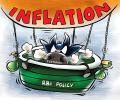
The RBI's Monetary Policy Committee brainstormed the impact of any future shocks on the inflation trajectory and stressed monitoring the cumulative effect of monetary policy actions over the past one year, which is still unfolding, revealed minutes of the rate-setting panel released on Thursday. The minutes of the meeting of the Monetary Policy Committee (MPC), headed by Reserve Bank Governor Shaktikanta Das, also indicated it would be premature to declare an end to the monetary tightening cycle, which started in May 2022 to check high inflation following the outbreak of the Russia-Ukraine war. The central bank, which effected six back-to-back hikes in the key short-term lending rate (repo) since May 2022 to check high inflation, decided to take a pause early this month.

RBI Governor Raghuram Rajan has said falling oil prices act as a cushion for CAD, adding it is time India does away with restrictions on gold imports

Believe it or not, the regulator is even stretching its arm to identify stressed borrowers and gauge the 'distance to default' as a measure of a particular bank's fragility, reveals Tamal Bandyopadhyay.

'Today, we have 150,000 orders a month. And a monthly sale of Rs 1 crore.'
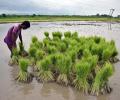
Among the key demands of agitating farmers has been a legal guarantee on minimum support price (MSP). The protest reached a crescendo when thousands of farmers from Punjab and elsewhere marched towards Delhi late last year and decided to block the main entry points once they were denied entry. The Centre, on its part, held 11 rounds of discussions with the protesters and even offered to amend some of the provisions without much success. With now one of their chief demands met, farmers have now moved on to force the government to concede on MSP.

Uttar Pradesh Bharatiya Janata Party's working committee member Ram Iqbal Singh on Thursday said there would have been no agitation by farmers had the Centre consulted them before enacting the new agricultural laws.

The World Bank must become Archimedes's lever to help change the world into a more prosperous, inclusive, and sustainable planet in the 21st century. The change in leadership now provides that opportunity, observes Ajay Chhibber.
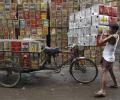
Major edible oil companies, including Adani Wilmar and Ruchi Soya, have reduced the maximum retail price (MRP) of their products by 10-15 per cent to provide relief to consumers, industry body SEA said on Monday. The prices have been reduced by Adani Wilmar (on Fortune brands), Ruchi Soya (Mahakosh, Sunrich, Ruchi Gold and Nutrella brands), Emami (Healthy & Tasty brands), Bunge (Dalda, Gagan, Chambal brands) and Gemini (Freedom sunflower oil brands), it said. OFCO (Nutrilive brands), Frigorifico Allana (Sunny brands), Gokul Agro (Vitalife, Mahek and Zaika brands) and others have also reduced prices, it added.

Under Pradhan Mantri Kisan Samman Nidhi (PM-KISAN) scheme, the Centre provides an annual financial benefit of Rs 6,000 to eligible beneficiary farmers in three equal four-monthly installments of Rs 2,000 each.

The report admits that converting MSP to a floor price of auction on the eNAM portal will not completely solve the problem as the current data shows that average modal prices in e-NAM mandis is lower than the minimum support price in all commodities except urad.
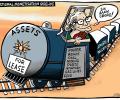
But use of that word -- privatisation -- is not encouraged. This seems to be a classic case of reforms through subtle signals, observes A K Bhattacharya.
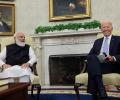
A top Republican lawmaker has welcomed India signing a trade deal with Australia, and urged the Biden administration to enter into a similar arrangement with New Delhi that can advance Washington's strong economic agenda in the strategically vital Indo-Pacific region. "I'm pleased to see #Australia & #India sign a strong trade deal," Senate Foreign Relations Committee Ranking Member Jim Risch said in a tweet. "The US needs to do the same and advance a strong economic agenda in the #IndoPacific. "The Biden Admin's failure to lead hurts US growth and our partnership in the region," Risch said in another tweet.

India's gig workforce is expected to expand to 2.35 crore by 2029-30 from 77 lakh in 2020-21, a NITI Aayog report said on Monday, and recommended extending social security measures for such workers and their families in partnership mode as envisaged in Code on Social Security. The report titled 'India's Booming Gig and Platform Economy' further said gig workers are expected to form 6.7 per cent of the non-agricultural workforce or 4.1 per cent of the total livelihood in India by 2029-30. Gig workers can be broadly classified into platform and non-platform workers.

A good agricultural harvest and a timely arrival of monsoon, besides a slew of government schemes, have also come as a bounty.

In May, Satpal Singh, who runs a dairy business with three buffaloes in Jewar, near Noida, was worried about the steep spike in input costs. Singh said dry fodder rates, which cost Rs 1,500-2000 per tractor trolley last year, were quoting at Rs 4,500-5,000. The price of other cattle feed ingredients (that include mustard meal and similar mixes) had also gone up from Rs 2,000 per quintal to Rs 3,100-3,200 per quintal.

Breaking a long tradition, the PMO has ensured that specific divisions in each ministry are allocated to junior ministers.

We have our own problems for sure and they are not trivial, but for now, our economy is in not too bad a shape, our politics is as personality-driven and authoritarian as that of most countries in the world. We must make the best of what we have and not be excessively unhappy looking at the grass on the other side of the septic tank which may not be greener after all!, observes Shreekant Sambrani.

India has been at the forefront of efforts at the UN to push for urgent long-pending reform of the Security Council, emphasising that it rightly deserves a place at the UN high table as a permanent member.

The ten trade unions are National Trades Union Congress, All India Trade Union Congress, Hind Mazdoor Sabha, Centre of Indian Trade Unions, All India United Trade Union Centre, Trade Union Coordination Centre, Self Employed Women's Association, All India Central Council of Trade Unions, Labour Progressive Federation and United Trade Union Congress.

The Russia-Ukraine crisis, along with general bullishness in agricultural commodities, has ensured that after a fairly long time, most of the 24 commodities for which the Centre declares the minimum support price (MSP) are trading above it. The exceptions here are chana or gram and a few varieties of pulses. This might gladden the farmers, especially those who are still holding on to their stocks from the previous kharif harvest or are harvesting the latest rabi crop. But this could stoke retail and wholesale inflation.
Critics argue that much more could have been done and that the government was slow to react to many events.

Critics who cannot stop gloating, pronouncing Modi to be a lame-duck prime minister, may be making a huge mistake, predicts Virendra Kapoor.

Even as the Indian benchmarks, the BSE Sensex and Nifty 50, crumbled over three per cent today, experts are optimistic about the Indian economy and believe investors can still make 30 per cent plus returns in 2015

India has demanded resumption of export benefits to certain domestic products under GSP, and greater market access for its products from sectors like agriculture, automobile, auto components and engineering. On the other hand, the US wants greater market access for its farm and manufacturing products, dairy items and medical devices, data localisation, and import duties cut on some ICT products.

Prime Minister Modi has certainly pulled back, and his political capital -- dependent as it is on an image that he knows best and never retreats -- may have taken a bit of a beating. But, equally, it is hard to say that the protesters have 'won', argues Mihir S Sharma.

Releasing a report titled 'Profiting from Pain' in Davos, the rights group further said as the cost of essential goods rises faster than it has in decades, billionaires in the food and energy sectors are increasing their fortunes by $1 billion every two days.

There will be uncertainty about outcomes,but one must hope for the best, observes T N Ninan.
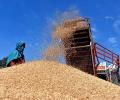
India is looking to tap its diplomatic missions abroad to enable grain exporters in the country to ship out wheat and corn as supplies from Russia and Ukraine are expected to remain disrupted for some time to come. Between the two items, pushing for wheat is easier because of a huge domestic surplus. "We are hand holding our exporters and support from various Indian missions abroad is also being channelised accordingly," a senior government official said. Global wheat prices have jumped since the Ukraine crisis started, with wheat futures in the US reaching their highest levels since 2008.
